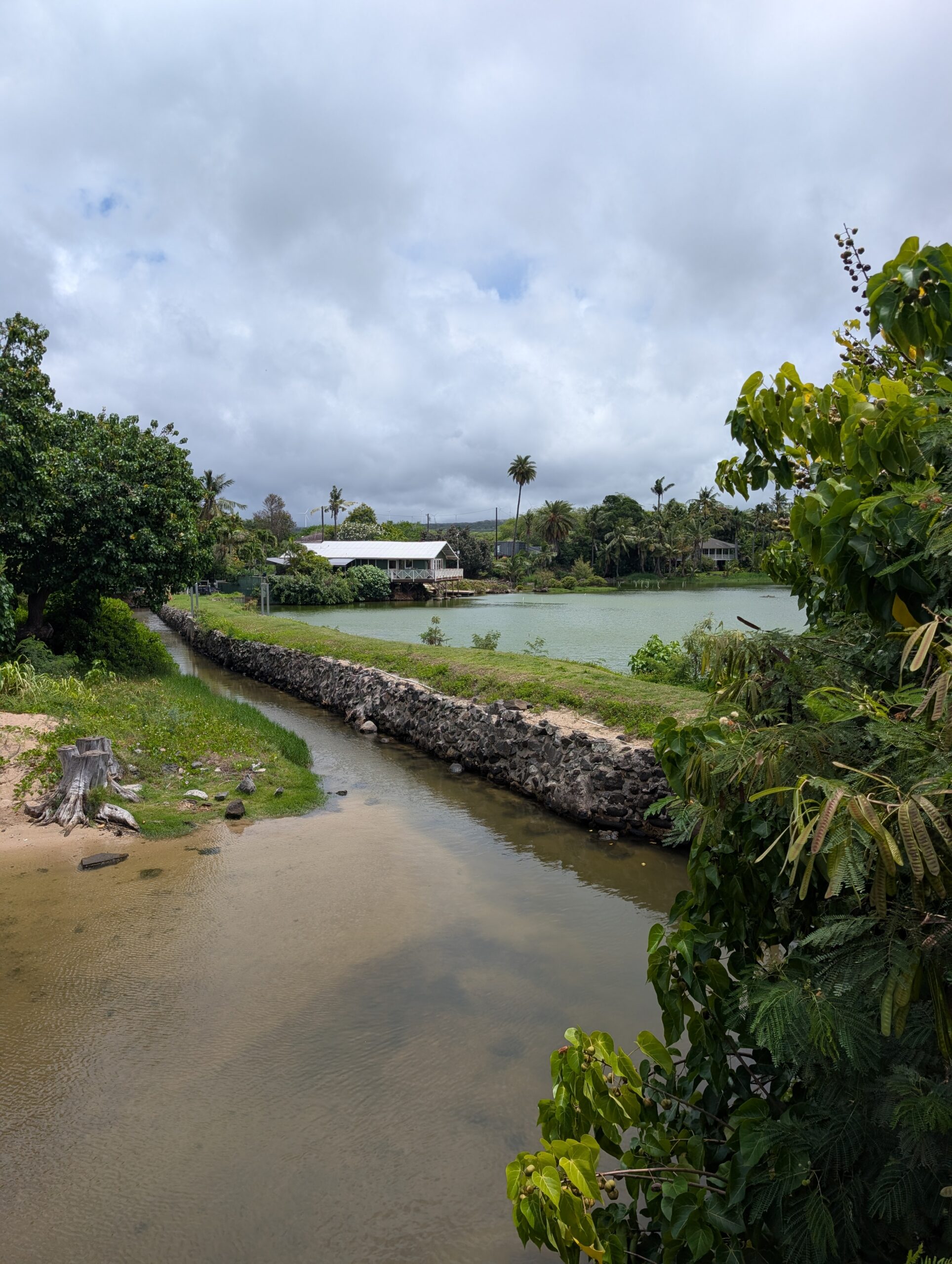
Located in Haleʻiwa on the North Shore of Oʻahu, Loko Ea (also written as Lokoea) stands as a remarkable testament to traditional Hawaiian aquaculture, engineering ingenuity, and royal history.
1. The Science and Engineering of the Mākāhā (Sluice Gate)
One of the most sophisticated technological innovations in ancient Hawaiian aquaculture was the mākāhā (sluice gate) .
- Ingenious Functional Design: The mākāhā was engineered to allow small, juvenile fish to enter the pond from the ocean or channel to feed on abundant algae [2, 3]. Once the fish grew well-fed and fat inside the pond, they became too large to escape through the gate’s narrow openings.
- Traditional Materials: Traditional gates were crafted using straight slats of ʻōhiʻa ʻai (mountain apple wood) securely lashed together with cords made from ʻie (a woody vine) [2, 3]. Precisely measured half-inch gaps were left between the wooden slats to control the passage and size of the fish.
- Brackish Water Ecosystem: Traditional Hawaiian fishponds thrived where freshwater streams or springs mixed with salty seawater, creating a nutrient-dense brackish water environment. This provided ideal conditions for raising prized fish species such as ʻamaʻama (mullet), moi (threadfish), āholehole (silver perch), and awa (milkfish).
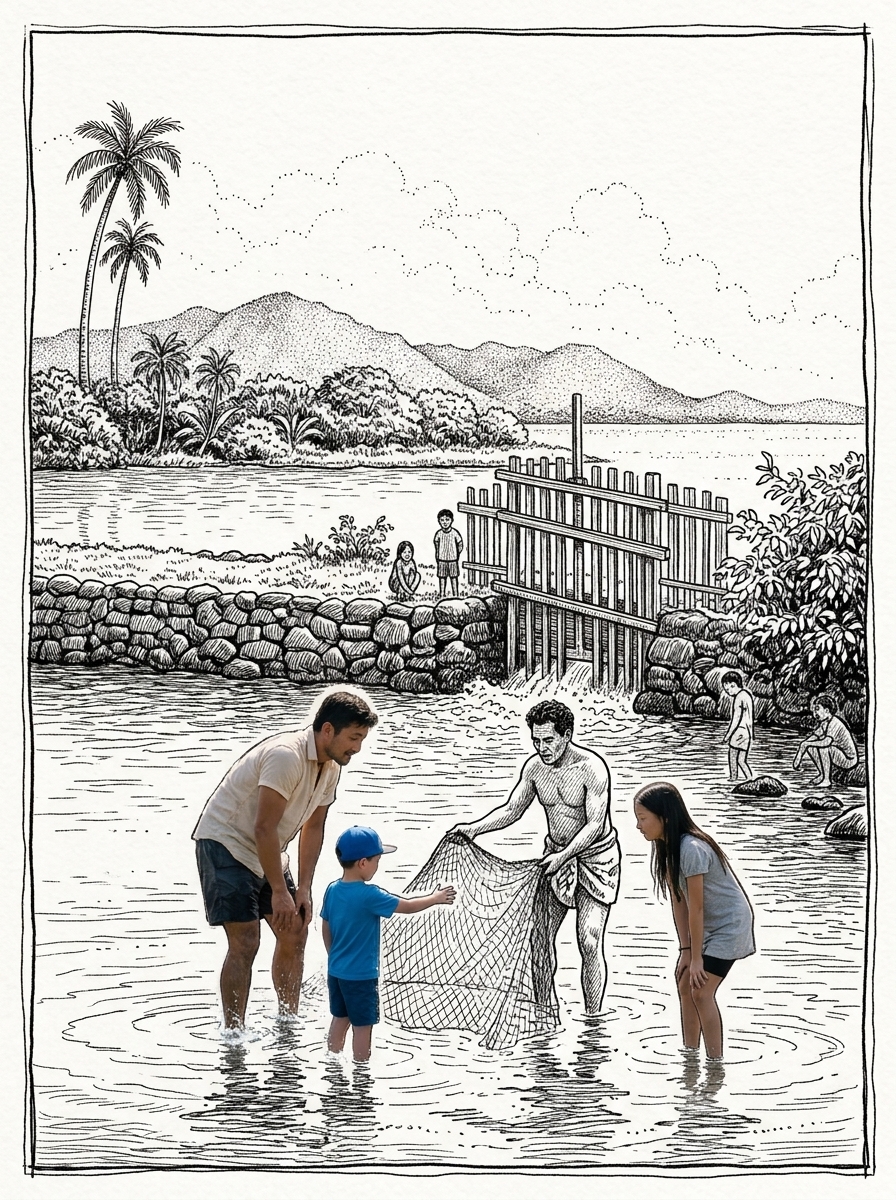
Loko Ea underwent dredging in the 1960s to deepen the water to 1–4 feet, transforming it into a three-pond complex equipped with two mākāhā.
2. Hydrology and Classification as a Puʻuone
Loko Ea is classified as a puʻuone, meaning a “pond near shore” formed by sand dunes or coastal estuaries.
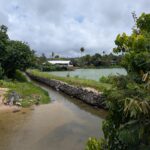
The pond encompasses a 6.75-acre system comprising three distinct bodies of water [1]. Freshwater originates from an upwelling spring near neighboring ʻUkoʻa Fishpond, flowing into a small side pond known as Keiki Pond [1]. The freshwater then flows into the main body of Loko Ea and connects to Waialua Bay via a saltwater channel, maintaining the delicate brackish balance necessary for a productive ecosystem.
3. Royal Heritage and Hawaiian Oral Traditions
Loko Ea holds a prominent place in Hawaiian history and mythology, deeply intertwined with the ruling class (aliʻi) and spiritual caretakers (konohiki):
- Legacy of Aliʻi Ownership: The fishpond passed through a long succession of Hawaiian royalty, including Queen Kaʻahumanu, King Kamehameha III, Victoria Kamāmalu, Ruth Keʻelikōlani, and Princess Bernice Pauahi Bishop [4]. In the late 19th century, Queen Liliʻuokalani maintained a summer home nearby and frequently enjoyed swimming in a spot adjacent to the pond.
- Chief Kakuhihewa and the Mullet: The great Oʻahu chief Kakuhihewa was famous for his love of ʻamaʻama (mullet) harvested from Loko Ea. Legend tells of his fleet-footed runners who could circle the island up to twelve times in a single day to deliver fresh, wriggling fish to the chief.
- The “Mullet God” and Laniwahine: Oral traditions speak of a sacred “Mullet God” living in the pond—a large white fish that would lead schools of fish into the pond to be harvested [1]. According to strict kapu managed by the konohiki, this sacred white fish was never to be caught or eaten [1]. Furthermore, Hawaiian historian Samuel Kamakau documented tales of Laniwahine, the moʻo (guardian water spirit) of neighboring ʻUkoʻa Fishpond, who was occasionally spotted in the waters around Loko Ea.
4. Preservation and Future Restoration
Today, Loko Ea and much of the surrounding land in Haleʻiwa belong to Kamehameha Schools [4]. A major \$4.5 million development and management plan has been initiated to restore the pond complex, preserve its historic features, and support community education.
Loko Ea remains a living cultural treasure, demonstrating how ancient Hawaiians sustainably managed natural resources while honoring the spiritual connection between land and sea.
References
- Cheever, D., & Cheever, S. (2003). Pōhaku: The Art & Architecture of Stonework in Hawaiʻi.
- James, V. (2010). Ancient Sites of Oʻahu: A Guide to Hawaiian Archaeological Places of Interest (Revised ed.). Mutual Publishing.
- Beyond the Surf: The Lost Grand Resort That Named Haleiwa
 Before Haleiwa became world-famous as the epicenter of Oahu’s North Shore surfing, it was home to one of Hawaii’s earliest and most glamorous luxury escapes: the **Hale’iwa Hotel** [1]. Opened in 1899, this Victorian-style resort… Read more: Beyond the Surf: The Lost Grand Resort That Named Haleiwa
- Discovering Loko Ea: The Science, Legends, and Royal Legacy of Haleʻiwa’s Ancient Hawaiian FishpondLocated in Haleʻiwa on the North Shore of Oʻahu, Loko Ea (also written as Lokoea) stands as a remarkable testament to traditional Hawaiian aquaculture, engineering ingenuity, and royal history. 1. The Science and Engineering of… Read more: Discovering Loko Ea: The Science, Legends, and Royal Legacy of Haleʻiwa’s Ancient Hawaiian Fishpond
- Discovering Puʻu o Mahuka Heiau: The Secrets of North Shore’s Sacred StonesPerched high on a rocky promontory in Pūpūkea, overlooking the sweeping expanse of Oʻahu’s famous Waimea Bay and Waimea Valley, sits Puʻu o Mahuka Heiau. Spanning roughly 8,000 square feet, it is one of the… Read more: Discovering Puʻu o Mahuka Heiau: The Secrets of North Shore’s Sacred Stones
- The 19th-Century Whaling Industry: The Original Venture Capital ModelDid you know that the structural playbook of modern venture capital (VC) wasn’t invented in Silicon Valley in the 20th century? Its true historical archetype emerged over two hundred years ago in the high-stakes, dangerous… Read more: The 19th-Century Whaling Industry: The Original Venture Capital Model
- Guided by Stars and Swells: Where Did Polynesians Come From and How Did They Reach Hawaii?Introduction Isolated in the vast expanse of the Pacific Ocean, the Hawaiian Islands are among the most remote landmasses on Earth. How ancient voyagers reached these islands without modern navigational instruments remains one of the… Read more: Guided by Stars and Swells: Where Did Polynesians Come From and How Did They Reach Hawaii?