In the early 19th century, the Hawaiian Kingdom underwent a socio-economic metamorphosis that was as rapid as it was irreversible. For centuries, the archipelago had flourished in isolation, governed by a sophisticated system of land management and religious law. This ended with the arrival of the global whaling fleet—maritime “floating cities” that appeared on the horizon and transformed the islands into the commercial emporium of the North Pacific. While the whaling era is often romanticized as a period of unprecedented prosperity, a rigorous socio-economic analysis reveals a darker undercurrent. The industry did not merely bring trade; it anchored the Kingdom in a precarious cycle of national debt and foreign dependency. This fiscal “debt-trap,” initiated by the sandalwood trade and solidified by the whaling boom, ultimately forced a revolution in land ownership that paved the way for the Kingdom’s eventual loss of sovereignty.
Foundations of the Hawaiian World: Pre-Contact Economy and Society
Ancient Hawaii was defined by a highly organized subsistence economy rooted in the ahupua’a system, where land districts extended from the mountain peaks to the sea. This structure ensured that every community had access to the full spectrum of resources, from timber to taro.
- Domestic Economy and Engineering: The heart of Hawaiian life was the cultivation of wet-land taro ( kalo ), which utilized intricate irrigation ditches ( auwai ) and terraced ponds—engineering feats that represented the pinnacle of Pacific agriculture. While men served as the primary farmers and fishermen, women specialized in the production of kapa (bark cloth). The “musical performance” of the kapa beaters was a hallmark of the ancient economy, where women used rhythmic strikes against wooden anvils to send “telephonic messages” across neighborhoods.
- Social Hierarchy and the Kapu System: Society was governed by the Alii (chiefs), supported by the kalaimoku (counselors skilled in statecraft). The Kapu system provided the religious and legal framework, regulating everything from diet to resource conservation and maintaining the rigid social stratification.
- Traditional Land Tenure: The Hawaiian concept of land was fundamentally communal.
- The King, or Alii-aimoku , served as the supreme land manager and head of property, rather than a private owner in the Western sense.
- Land was held “by the chiefs and people in common.”
- The Makaainana (commoners) held inherent rights to live on and cultivate the land, provided they offered labor and produce to their respective chiefs.
The First Pivot: Sandalwood and the Introduction of Credit
The transition from subsistence to a market economy began with the sandalwood trade, established as a royal monopoly by Kamehameha I. This era introduced the Kingdom to the predatory mechanics of international maritime credit. As the demand for sandalwood in Canton peaked, foreign traders transitioned from bartering trinkets to issuing promissory notes.These debts were not denominated in currency but in piculs of “good merchantable sandalwood,” with one picul equaling 133-1/3 pounds of labor-intensive timber. This period saw the first instances of national “debt-trapping,” as foreign traders sold the Alii luxury goods and maritime vessels at exorbitant rates. Many of these ships, such as the Cleopatra’s Barge and the Thaddeus , were “rotten” or nearly worn out at the time of sale, becoming worthless soon after. By 1822, the Kingdom’s debt was estimated between 22,500 and 23,000 piculs of sandalwood, creating a fiscal burden that the subsequent whaling industry would inherit and formalize.
The Whaling Boom: Hawaii as the Hub of the North Pacific
As sandalwood forests were depleted, the whaling industry emerged as the new economic engine. Hawaii’s strategic location relative to the “Japan grounds” and the “Kodiak grounds” made Honolulu and Lahaina indispensable for the North Pacific fleet. The ports operated on a seasonal “refreshing” cycle, with ships arriving in the Spring and Fall to repair, take on water, and replenish “refreshments” (domestic produce).The following table illustrates the meteoric rise of this commercial activity:| Year | Ships (Honolulu & Lahaina) | Value of Domestic Produce Supplied | Note || —— | —— | —— | —— || 1824 | 104 | Not recorded | Start of the boom || 1832 | 198 | Not recorded | Average for 6 years: 172 ships || 1844 | 490 | $60,400.00 | Expansion of sugar/provisions || 1846 | 596 | $170,800.00 | Peak of the Whaling Era || 1853 | 245 | $126,925.00 | Onset of industry decline |
The Hierarchy of the Harpoons: Power Dynamics of the Trade
The whaling ecosystem created a new, rigid power structure that often undermined Hawaiian law.
- Investors and Owners: Capitalists in New England viewed Hawaii as a site for high-stakes “South Sea speculation,” demanding that the Kingdom facilitate maximum returns regardless of the social cost to the native population.
- Captains as Commercial Agents: Beyond their nautical command, captains acted as diplomatic proxies. Backed by the presence of foreign warships like the U.S.S. Vandalia or the H.M.S. Carysfort , they exerted immense pressure on the Hawaiian government to relax morality and temperance laws to accommodate their crews.
- The Pro-Consul and the Sailor: The influx of “dissolute and unprincipled sailors” brought social friction to port towns. However, it also saw the rise of the Kanaka (native Hawaiian) sailor, as thousands of young men joined crews to escape the increasing labor taxes and the breakdown of traditional agricultural life.
Debt and Diplomacy: The 1826 Treaty and the Sandalwood Tax
In 1826, the fiscal pressures of the sandalwood era reached a legal climax. Captain Thomas ap Catesby Jones negotiated the “Articles of Arrangement,” the first formal treaty between Hawaii and a foreign power. To settle an outstanding $200,000 claim from American traders, the government enacted the Kingdom’s earliest written tax law on December 27, 1826.This law required every able-bodied man to deliver half a picul of sandalwood to the authorities or, as a sign of the encroaching cash economy, pay “four Spanish dollars.” This legal coercion forced the Hawaiian government to prioritize foreign economic satisfaction over domestic stability, demonstrating that independent sovereignty was increasingly contingent upon satisfying Western debt.
The “Great Mahele” and the End of Feudalism
By the 1840s, foreign advisors such as William Richards, Dr. Gerrit P. Judd, and John Ricord argued that the ancient communal land system was the primary “obstacle to progress.” Ricord famously characterized the commoners as “degraded serfs” under the feudal system to justify a transition to “Fee Simple” (private) ownership.The 1839 Declaration of Rights and the 1840 Constitution, influenced by these advisors, declared that land belonged to the “chiefs and people in common.” This culminated in the “Great Mahele” (land division), which allowed for allodial titles. The advisors argued that private property was necessary to provide collateral for foreign loans and to stimulate systematic agriculture like sugar. However, the complexity of the “Kuleana” grant process meant that many commoners, lacking capital and legal expertise, lost their ancestral lands to foreign speculators, effectively ending the traditional Hawaiian social contract.
Socio-Economic Impact: The Four Fatal Impacts
The whaling era’s human and cultural cost was devastating, marked by what historians categorize as the “Four Fatal Impacts”:
- Disease and Depopulation: Foreign contact introduced catastrophic epidemics. The native population plummeted from approximately 130,312 in 1832 to just 84,165 by 1850—a staggering 35% decline in less than two decades.
- Abandonment of Traditional Agriculture: The shift toward port-centered wage labor and the crushing demands of the sandalwood tax led to the widespread neglect of taro cultivation and the ahupua’a system.
- The Social Vacuum: The 1819 abolition of the Kapu system, occurring just as the whaling boom began, left a cultural and moral “vacuum” that made the population vulnerable to the predatory aspects of the waterfront.
- Foreign Intoxicants: Despite the efforts of the Kuhina-nui (Premier) and other chiefs to maintain temperance, the 1838 liquor law was effectively repealed under the threat of French and British naval intervention, leading to social instability.
Conclusion: The Legacy of a Bound Kingdom
The whaling industry was the engine that pulled Hawaii into the global marketplace, but it did so with a heavy chain of debt and dependency. The transition from a communal feudalism to a private property regime was a direct response to the fiscal pressures of the maritime era. By the mid-1850s, the Kingdom lived in the “Shadow of Destiny,” with its leaders—including Kamehameha III—openly discussing annexation by the United States as a desperate means of finding stability. The “Golden Age” of whaling was, in reality, a period of structural erosion that left Hawaii vulnerable to the global powers that had spent decades anchoring the Kingdom in debt.
References
- Kuykendall, R. S. (1938). The Hawaiian Kingdom, 1778-1854: Foundation and Transformation . University of Hawaii Press.
- Malo, D. (1903). Hawaiian Antiquities (Moolelo Hawaii) (N. B. Emerson, Trans.). Honolulu.
- National Park Service. (2010). Native Hawaiians, Pacific Islanders, and the Jewish Community in New Bedford Whaling & Whaling Heritage . Ethnography Program Northeast Region.
- Vancouver, G. (1798). A Voyage of Discovery to the North Pacific Ocean, and Round the World . London.
- Wyllie, R. C. (1851). Historical Summary: Report of the Minister of Foreign Relations . Archives of Hawaii.
Reflections: Whaling, Debt, and the Socio-Economic Transformation of 19th-Century Hawaii
1. The Paradox of Isolation: A Global Hub in the Pacific
One of the most striking revelations is how the Hawaiian Islands—seemingly isolated in the heart of the Pacific—were, in fact, a vibrant crossroads of international trade.
The opulence of Iolani Palace and the artifacts of the Monarchy, which we can still see today, mirror the grandiosity of European Royal Courts. I had long wondered how such cutting-edge technology, luxury goods, and European philosophies reached these shores. My preconception was that Hawaii, being so far from the continents, lacked the resources for such development.
However, its unique geography turned it into a vital maritime hub. The bountiful marine resources (whaling) and the stable tropical climate became powerful commodities. This brought significant wealth to the Kamehameha Dynasty but also swept the islands into the global tide of urbanization and economic expansion—ultimately eroding traditional Hawaiian culture and depleting its seemingly “infinite” natural resources.
2. The Weight of Debt: A Nation Consumed by Capital
The “debt” mentioned in the title serves as a haunting metaphor for the fall of the Kingdom. The excessive spending on luxury goods to maintain a “Westernized” image strained the national treasury, creating a fatal vulnerability.
This financial fragility paved the way for Hawaii to be swallowed by the overwhelming capital, military might, and political influence of the United States and Great Britain. This is not just a 19th-century tragedy; it is a reality that many of us feel in our globalized lives today. We are forced to ask: What can we learn from this to safeguard our future?
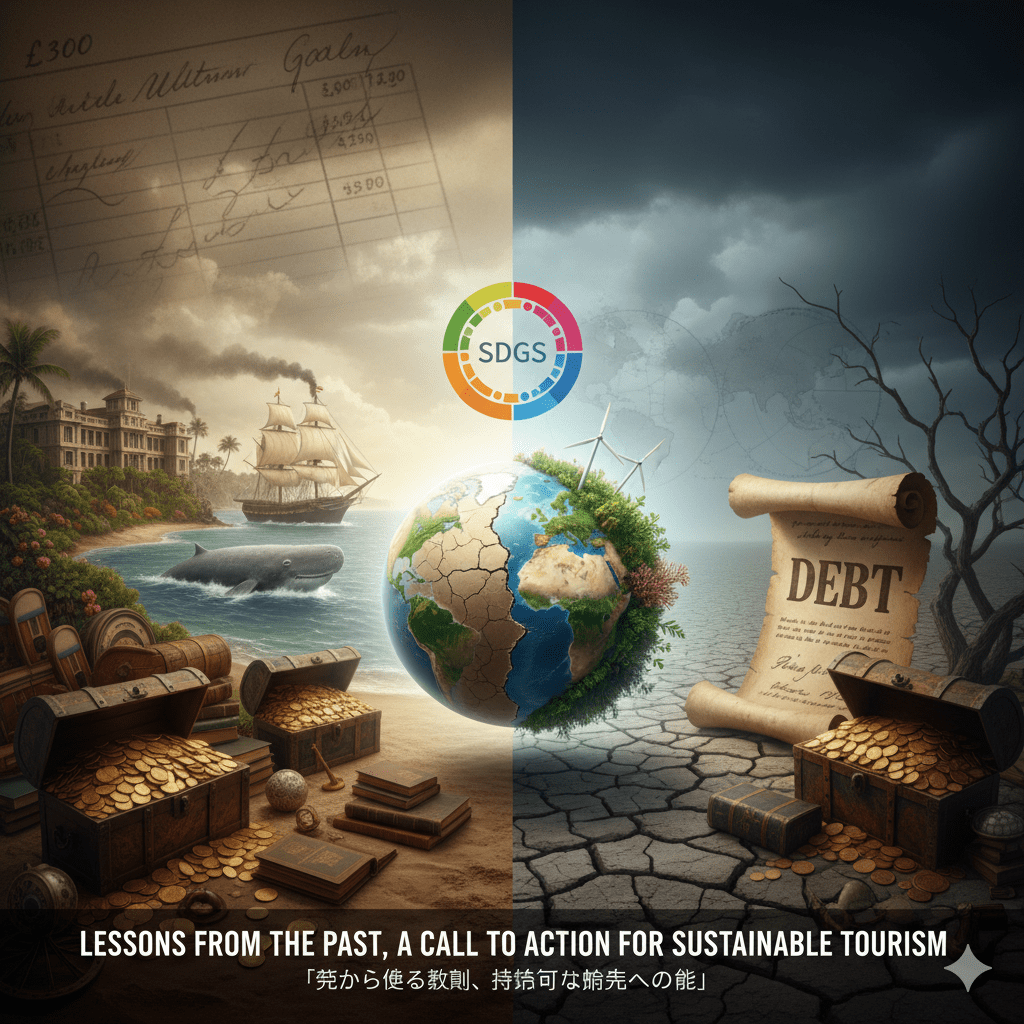
3. A Modern Perspective: From Resource Depletion to SDGs
The lessons of 19th-century resource exhaustion are directly linked to modern-day SDGs (Sustainable Development Goals) and Hawaii’s current environmental initiatives.
Living in the middle of the Pacific, Hawaii is on the front lines of climate change. The environmental shifts we face today—such as global warming—are immediate threats to these islands. By studying the history of how Hawaii’s nature was once exploited, we can better understand the necessity of Sustainable Development and Regenerative Tourism.
I hope to continue researching and sharing information with you, my readers, as we explore how to harmonize economic life with the preservation of our fragile natural world.