When visiting Hawaiʻi, travelers often admire the majestic black lava walls, intricate stone fishponds, and historic coral churches. In traditional Hawaiian culture, stone—known as pōhaku—is far more than a physical building material; it is a vital connection to history, community, and the sacred spiritual power known as mana.
1. The Spiritual and Daily Lifeline of Hawaiian Pōhaku
In pre-contact Hawaiʻi, metals were unavailable, making stone the ultimate foundation of survival, craftsmanship, and religion.
- Spiritual Power (Mana): Every stone was understood to possess its own mana. Sacred rocks were sometimes set up as representations of deities—such as black lava rock for Kū (god of sea and fishing) or white coral for Hina—and served as sacred altars in temples (heiau).
- Craftsmanship and Tools: High atop the frigid, 15,000-foot summit of Mauna Kea, skilled craftsmen operated a massive adze quarry, extracting dense basalt to shape hand tools. Artisans also carved pōhaku into poi pounders, weapons, and game stones (ʻulu maika).
- Community Alignment (Human Chains): Constructing large stone monuments required extraordinary social coordination. To build major temples or fishponds, thousands of people formed human chains stretching over a mile, passing heavy basalt rocks hand-to-hand from quarries or valley fields without letting a single stone touch the ground.
2. Chronological Evolution of Hawaiian Stonework
As Hawaiʻi transitioned from an isolated archipelago to a global kingdom and modern territory, stone architecture evolved dramatically across four distinct eras.
Epoch 1: Pre-Contact Era (Prior to the late 18th Century) – Dry-Stack Masonry
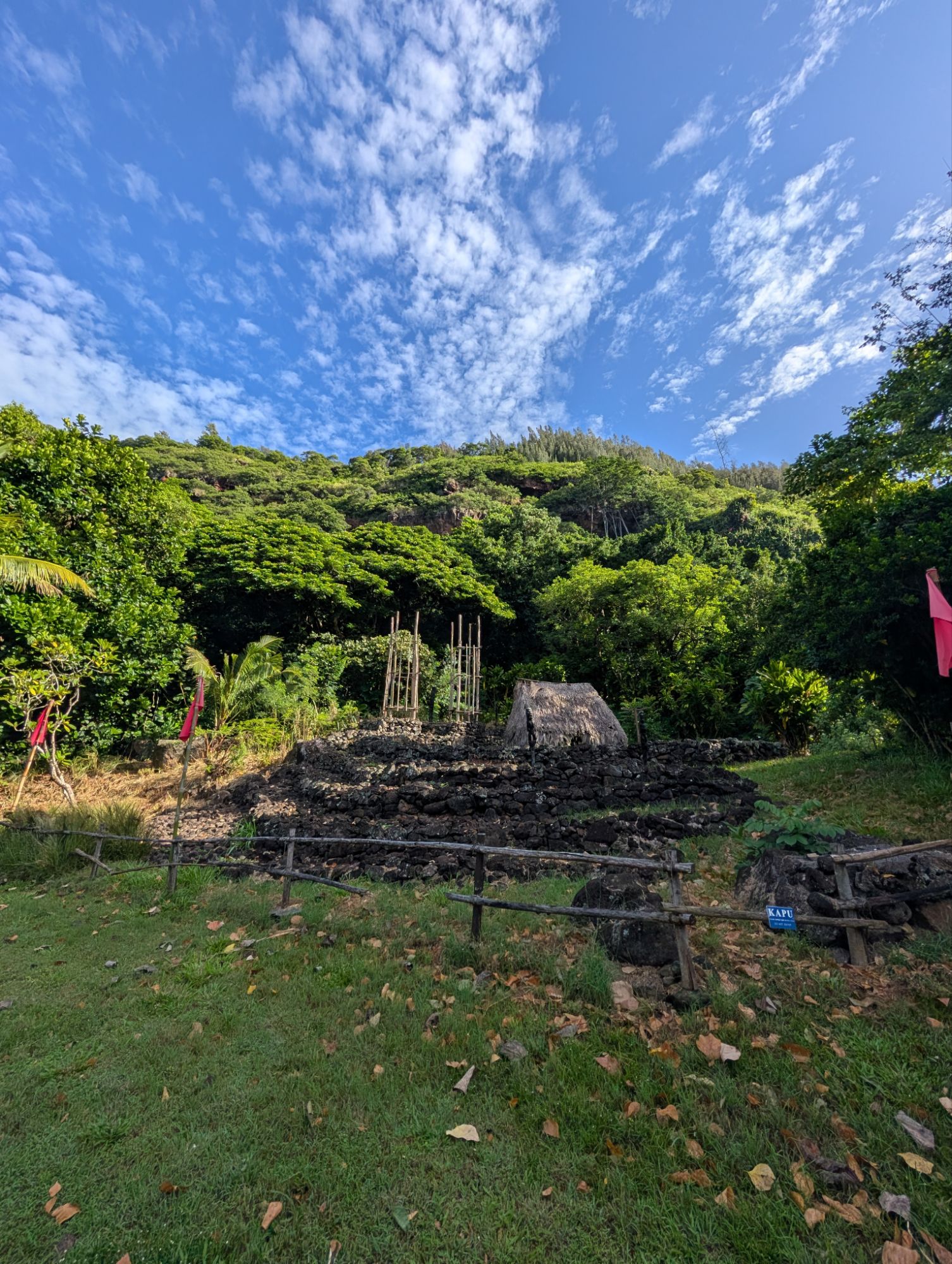
- Technique: Ancient Hawaiians mastered dry-stack masonry (paʻa pōhaku), fitting raw field stones and basalt together tightly without any mortar or binding agents.
- Key Landmarks:
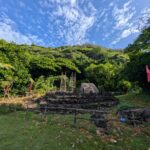
- Puʻu o Mahuka Heiau (1600s): A prominent temple overlooking Waimea Bay built from man-sized basalt stones fitted without mortar.
- Pearl Harbor Fishponds (1500s): Over 27 extensive walled fishponds built along the shoreline under Chiefess Kalaimanuia, utilizing lava rock and white coral barriers.
Epoch 2: Early Kingdom & Transition (Late 18th Century – 1840s) – Coral Block Masonry
- Technique: Contact with Western builders introduced lime mortar (made by burning coral in beachside kilns) and underwater coral block quarrying. Native Hawaiian divers dove 10 to 20 feet underwater to chisel massive coral slabs from off-shore reefs.
- Key Landmarks:
- John Young Residence (1798): Located at Kawaihae, representing one of the earliest hybrid structures combining Hawaiian stone traditions with Western domestic layouts.
- Chamberlain House (1831): Built for the Sandwich Islands Mission using roughly 5,000 coral blocks set in lime mortar.
- Kawaiahaʻo Church (1842): Often called Hawaiʻi’s Westminster Abbey, constructed using 14,000 underwater-quarried coral blocks.
Epoch 3: Kingdom Era (1850s – 1890s) – Western Architectural Revival & Innovation
- Technique: Royal building projects adopted European styles—such as Gothic Revival and Richardsonian Romanesque—incorporating dressed basalt, coral blocks, and early cast concrete.
- Key Landmarks:
- Royal Mausoleum / Mauna ʻAla (1865): A Gothic Revival chapel built with cut coral block walls and steep slate roofs.
- ʻIolani Barracks (1870s): A medieval castle-like structure crafted from over 6,000 coral blocks harvested from nearby reefs.
- Aliʻiōlani Hale (1874): Built with a natural stone foundation supporting early load-bearing concrete blocks cast to resemble European limestone.
- Bishop Museum (1891): Features Richardsonian Romanesque architecture constructed from dark basaltic stone quarried directly from adjacent Kamehameha Schools land.
Epoch 4: Early 20th Century (Modern Industrial Era) – Mōʻiliʻili Blue Basalt
- Technique: The opening of the Mōʻiliʻili Quarry (1889–1949) introduced industrial dynamite blasting, supplying high-grade “blue basalt” for public infrastructure, paving, and landmark buildings.
- Key Landmarks:
- Kakaʻako Pumping Station (1900): Industrial Richardsonian Romanesque structure crafted from rusticated cut bluestone.
- Fort Ruger (Early 1900s): Military fortifications around Diamond Head built with rustic basalt stonework guard posts and retaining walls.
- Central Union Church (1924): Features fine ashlar wall courses made of Mōʻiliʻili blue basalt stone.
3. Conclusion
From sacred temple platforms to coral cathedrals and basalt university halls, pōhaku embodies the resilience, artistry, and changing heritage of Hawaiʻi. The next time you visit the islands, look closely at these stone structures to hear the quiet stories carved into every block.
References
Cheever, D., & Cheever, S. (Coordinating Authors). (2003). Pōhaku: The art & architecture of stonework in Hawaiʻi (J. S. Clifford & F. S. Haines, Eds.). Edition Limited.
- Beyond the Stones: The Sacred Art and Architectural History of Hawaiian Pōhaku
 When visiting Hawaiʻi, travelers often admire the majestic black lava walls, intricate stone fishponds, and historic coral churches. In traditional Hawaiian culture, stone—known as pōhaku—is far more than… Read more: Beyond the Stones: The Sacred Art and Architectural History of Hawaiian Pōhaku
 - The Remarkable Achievements of Captain James Cook: The Navigator Who Mapped the PacificCaptain James Cook (1728–1779) was a British navigator, explorer, and cartographer who brought the Great Age of Discovery to its grand finale. Through his three landmark voyages across… Read more: The Remarkable Achievements of Captain James Cook: The Navigator Who Mapped the Pacific
- \Special Bonus!/ Free Optional Mini-Tour Included!All North Shore Shuttle passengers are welcome to join our FREE Optional Mini-Tour! Enhance your trip with a quick, local experience at no extra cost. 🌟 Highlights 📍… Read more: \Special Bonus!/ Free Optional Mini-Tour Included!
- The Ultimate North Shore Day Trip: Snorkeling at Shark’s Cove & Exploring HaleiwaThe Ultimate North Shore Day Trip: Snorkeling at Shark’s Cove & Exploring Haleiwa When people think of the North Shore, they think of big waves—but in the summer… Read more: The Ultimate North Shore Day Trip: Snorkeling at Shark’s Cove & Exploring Haleiwa
- 【North Shore Escape】Sunset Beach and Haleiwa: The Ultimate Day Trip PlanAloha! While the energy of Waikiki is undeniable, sometimes you just need to leave the city behind and embrace the “Island Time” of the North Shore. Today, I’m… Read more: 【North Shore Escape】Sunset Beach and Haleiwa: The Ultimate Day Trip Plan